
Caterpillar ECM Repair and Rebuilt Replacements for On-Highway Trucks


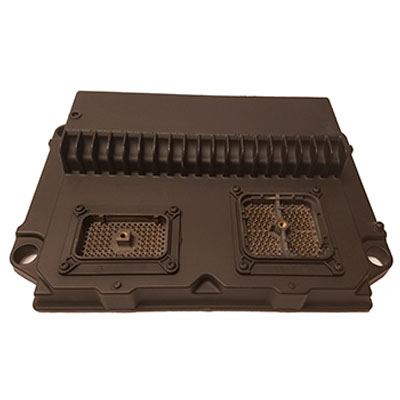
Caterpillar truck engines we cover, from the 3406E to the C-15
Diesel ECM Exchange repairs and rebuilds Caterpillar ECMs for on-highway truck engines, not construction equipment. We cover eight engine families:
- 3126 and 3176
- 3406 and 3406E
- C-7, C-10, and C-12
- C-13 and C-15
Each engine has its own page with pricing and serial-number options. Order a 3406 ECM for a 3406E rig or a 3126 ECM for the smaller 3126. You pick your engine serial number prefix, not a part number, because a Caterpillar ECM is identified by the engine it came off. The C-15 alone runs prefixes like 6NZ, MXS, NXS, and SDP.
Send in your Caterpillar ECM for repair, or buy a rebuilt unit outright
You can fix a Caterpillar ECM two ways, both with the same coverage: send in your module for repair, or buy a rebuilt unit outright.
On a repair, you are purchasing a repair service, not a replacement service. We send a pre-paid shipping label, you mail us your ECM, and your own rebuilt module ships back. If we cannot save it, every dollar you paid goes toward a rebuilt replacement.
On a buy-outright order, you get a rebuilt Caterpillar ECM that ships ready to install. Because the ECM belongs to the engine, you give us your engine serial number (ESN) after purchase and we program it to match before it ships. Returning your old core activates the free lifetime warranty. Diesel ECM Exchange adds a 60-day money back guarantee, with terms on our return policy, and ships free across the US.
Signs a Caterpillar ECM has failed
A failing Caterpillar ECM shows up in a few ways, and on engines like the C-7, C-10, and C-12, a lost connection to Caterpillar ET is often the first sign. Watch for:
- No link to Caterpillar ET or a generic scan tool
- A crank with no start despite good fuel and a charged battery
- Power loss, derates, or stalls that come and go with heat and vibration
The same no-start pattern shows up on other heavy-truck platforms we rebuild, like Cummins ECMs.
Why Caterpillar ECMs fail
Caterpillar ECMs fail from the inside out. The module is a circuit board bolted to a hot, vibrating diesel engine, and that heat, constant vibration, and moisture eventually crack a solder joint or kill a component.
The failures are often model-specific. On C-15 engines with the MXS serial prefix, NHTSA records a documented pattern of ECM failures, and certain C-7 engines are known for a module fault that causes a rough, stumbling warm-up. The fault sits in the electronics, which is what a rebuild fixes. We see the same on International and Navistar diesels.
How we rebuild and test every Caterpillar ECM
We keep Caterpillar ECM work in-house at our Raleigh, North Carolina shop, so the technicians who diagnose your module are the ones who repair it, with no subcontractor in between. Every rebuild is board-level: failed components and the parts known to fail on that module are replaced and resoldered, and cold solder joints get reflowed before testing starts.
A module only ships after it clears four bench checks:
- It communicates with a scan tool
- It accepts programming
- Its programming and stored parameters hold, not just load
- It reads correct on voltage
There is no road testing and no vehicle simulator in that process. The same Raleigh bench handles our Detroit Diesel rebuilds too.
FAQs
What is a Caterpillar ECM?
A Caterpillar ECM, or Engine Control Module, is the computer that runs a Caterpillar diesel engine. It manages fuel injection timing, turbocharger boost, air/fuel ratio, and engine speed using readings from sensors across the engine. When the ECM fails, the engine can lose power, throw codes, or refuse to start, because every fuel and timing decision runs through that one module.
How much does it cost to replace a Caterpillar ECM?
Cost depends on your engine and on whether you repair your own module or buy a rebuilt one outright. Each Caterpillar engine page lists current pricing and the serial-prefix options for that module. Open the page for your engine, such as the C-15 ECM, to see exact pricing before you order.
Is it worth repairing a Caterpillar ECM instead of buying new?
Repairing or rebuilding a Caterpillar ECM is usually far cheaper than a new dealer module, and it fixes the root cause. A rebuild replaces the failed and known high-fail components at the board, so the same fault does not return. A new ECM also still has to be programmed to your engine before it will run.
How long does a Caterpillar ECM repair take?
Allow 3 to 5 business days to rebuild and test your core once it reaches our Raleigh facility, plus 1 to 3 business days for delivery. A send-in repair adds shipping time each way, since the bench clock starts when your module arrives. A buy-outright rebuilt unit skips the inbound trip.
How do you reset a Caterpillar ECM?
A Caterpillar ECM is not reset like a consumer device; it is programmed by flashing the correct factory software onto it with a tool like Caterpillar ET. On a buy-outright order we load the latest factory software and handle that flash in our Raleigh shop before the module ships, so you do not need Cat ET or a dealer. A send-in repair returns your own module, rebuilt and tested.
Can I install a Caterpillar ECM myself?
A buy-outright rebuilt Caterpillar ECM ships programmed to your engine serial number and ready to install, so a capable owner or shop can mount it and wire it in without a dealer programming trip. A send-in repair returns your original module, so you reinstall the same unit you took out.

|
The most common questions related to exchanging your diesel ECM for one that works.
|